Phys
A deterministic calibration suite for testing whether video metrics respond to known physical errors.
- 24
- seeded oracle cases
- 10
- controlled candidates
- 240
- measured records
Problem
Before a video metric is used to interpret world-model output, its response to known physical errors should be calibrated rather than assumed from visual similarity alone.
Why it matters
A trustworthy calibration must separate metric insensitivity from simulator error, initial-condition drift, visual tracking confounds, and weak-model failure while keeping every claim inside the synthetic protocol that produced it.
Core contribution
PhysGauge injects controlled violations into an analytically verified two-disc world, then compares state-grounded physical checks with visual metric response under frozen severity sweeps.
- Validate the analytic oracle before interpreting metric behavior.
- Treat frame-order invariance as a bounded counterexample and preserve the correction in an erratum.
- Gate learned-model interpretation on capability and retain the preregistered inconclusive result when that gate fails.
Hero result
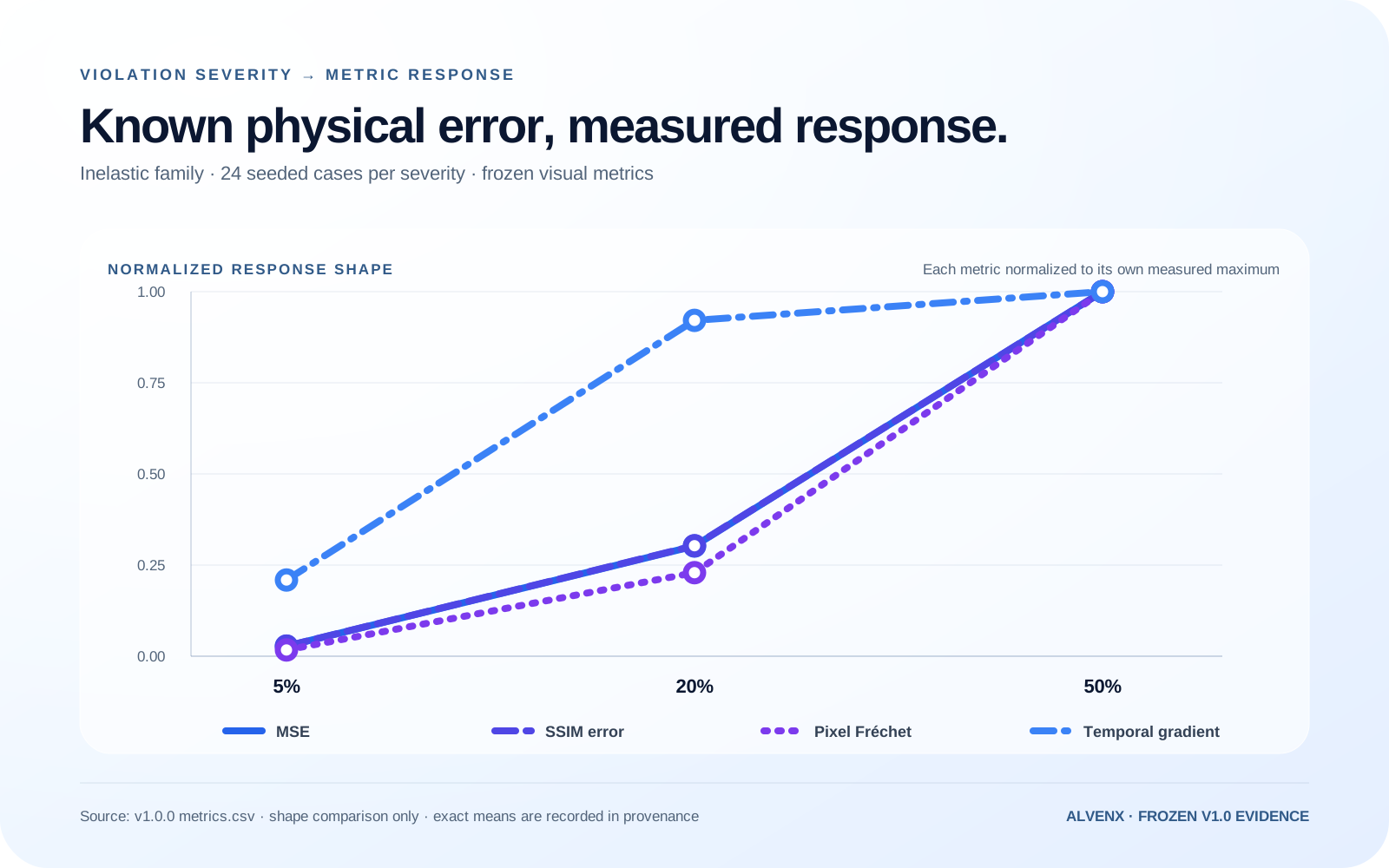
All 24 oracle rollouts passed the registered checks. State-grounded metrics detected every injected violation, and the four included visual metrics increased monotonically on the frozen inelastic and momentum-kick severity sweeps.
How it works
- 01
Validate the world
Check conservation, collision occurrence, and the registered analytic invariants for every seeded oracle rollout.
- 02
Inject known errors
Create controlled energy, momentum, collision, initial-state, random-state, and frame-order candidates.
- 03
Measure response
Evaluate state-grounded physical checks and four visual metrics across frozen severity levels.
- 04
Preserve interpretation
Hash the bundle, retain counterexamples, and apply preregistered gates before making a learned-model claim.
Evidence
The v1 bundle contains 24 cases × 10 candidates and a hash-verified report, CSV, records, matrix, and manifest. The separate R2 study remains inconclusive-model because all three predictors failed the preregistered capability gate.
Limitations
- 01
The frozen protocol covers equal-mass, two-dimensional rigid-disc collisions only.
- 02
State-grounded checks require simulator or model state; video-only output cannot receive the same law-specific guarantees.
- 03
R2 does not establish metric reliability on learned world models or generalization to real video; its result is inconclusive-model.
Reproduce
The current v1.1.2 software reproduces the deterministic CPU workflow and verifies the reviewable records, CSV metrics, report, sensitivity matrix, and SHA-256 manifest frozen at v1.0.0.
Windows PowerShell · Python 3.11–3.13. Run from a new checkout; each command uses its local virtual environment.
git clone --branch v1.1.2 --depth 1 https://github.com/AlbertXXuu/PhysGauge.git
cd PhysGauge
python -m venv .venv
.venv/Scripts/python.exe -m pip install -e .
.venv/Scripts/physgauge.exe doctor
.venv/Scripts/physgauge.exe run --output runs/my-calibration
.venv/Scripts/physgauge.exe verify --bundle docs/evidence/v1.0.0Release & maintenance
Closure maintenance patch.
Immutable protocol, evidence, and claims.
The v1.1.2 maintenance patch aligns the Studio navigation with the locked AlvenX product-header shell and preserves evidence verification across supported environments. The v1.0.0 calibration bundle remains immutable. The research line stays closed unless external use or a new preregistered protocol with an unseen split supplies evidence to reopen it.
Read the maintenance policy